
Historical white paper
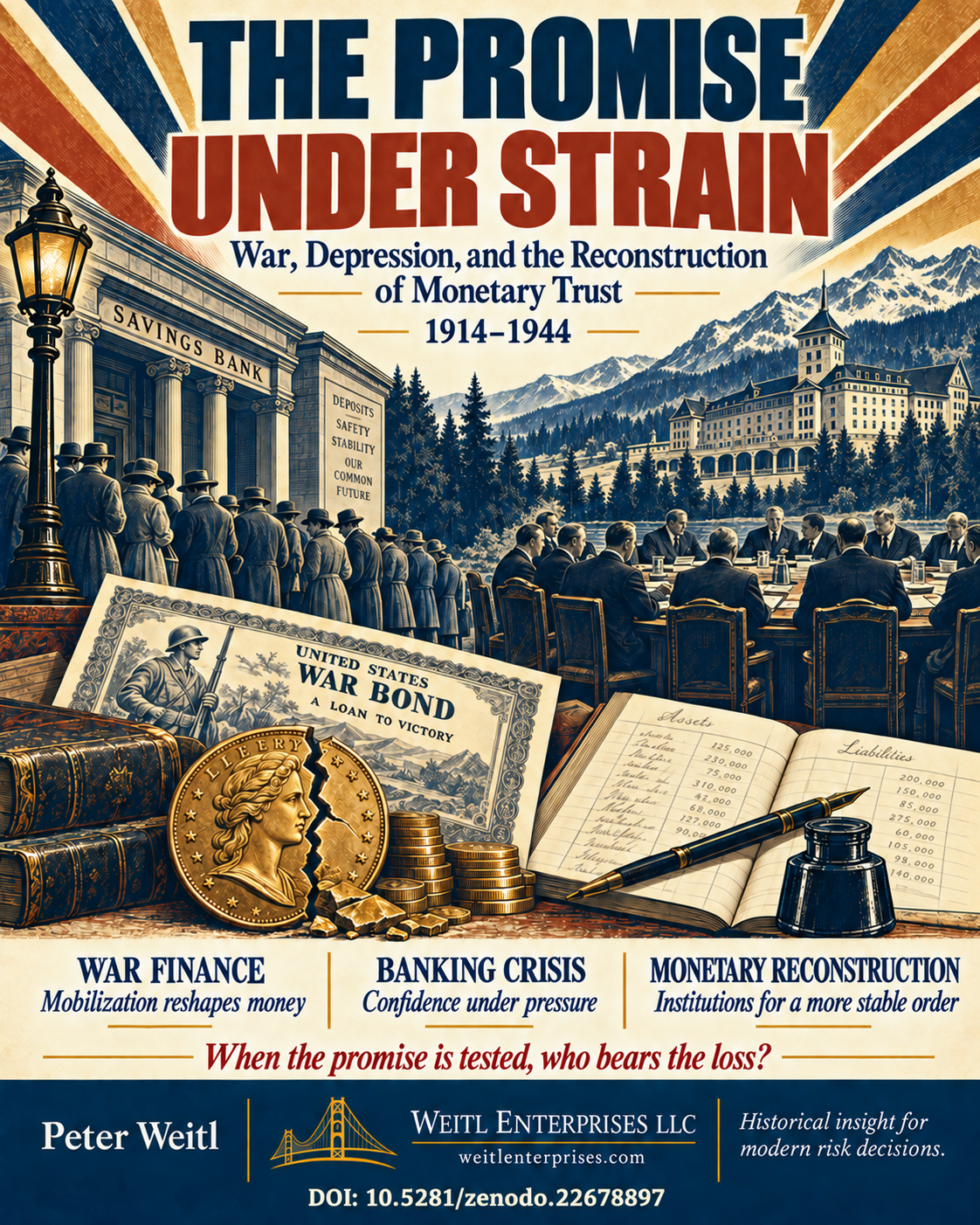
The Promise Under Strain
War, Depression, and the Reconstruction of Monetary Trust
Continuing the historical trajectory of The Bank and the State, this paper follows monetary institutions through war and depression from 1914 to 1944. Cases from Britain, Germany, the United States, and Japan examine how governments and banks rebuilt trust by changing the promises they supported and the distribution of losses.
Digital Object Identifier 10.5281/zenodo.22678897About the paper
When the promise was tested, who bore the loss?
From London’s payment crisis of 1914 and Germany’s hyperinflation to the American banking emergency and Bretton Woods, the paper distinguishes nominal payment, timely access, purchasing power, and external conversion. It compares emergency lending, capital support, deposit insurance, and changes to exchange commitments.
With 28 linked references, two explanatory figures, and three analytical tables, the paper connects historical evidence to the assessment of institutional risk. Its endpoint is the design agreed at Bretton Woods in 1944; ratification and the institutions’ later operations belong to the next stage of the series.
Cite this paper
Suggested citation
Weitl, Peter. The Promise Under Strain: War, Depression, and the Reconstruction of Monetary Trust, 1914–1944. Weitl Enterprises LLC, September 2026. https://doi.org/10.5281/zenodo.22678897