
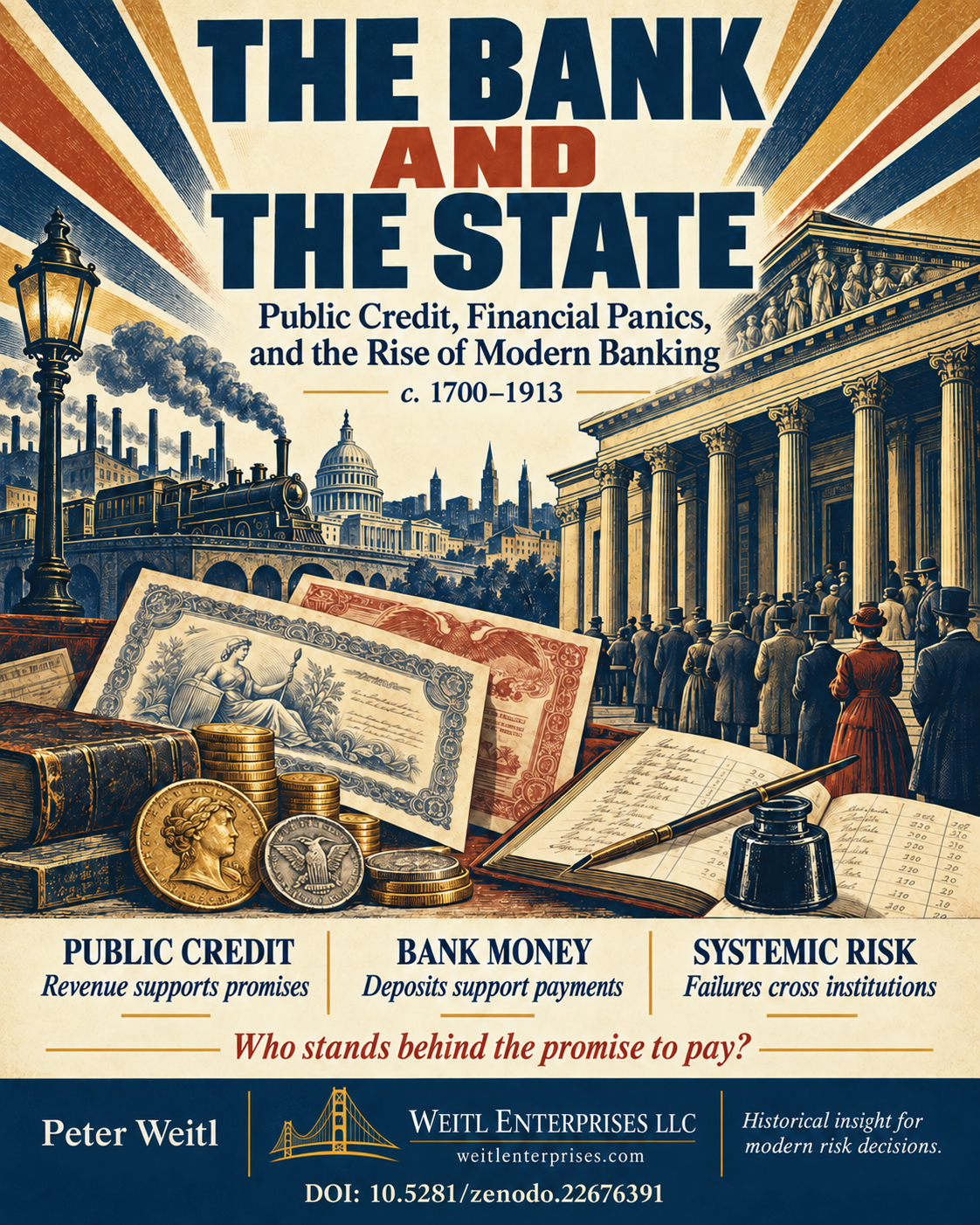
Historical white paper
The Bank and the State
Public Credit, Financial Panics, and the Rise of Modern Banking
Continuing the historical trajectory of After the Coin, this paper examines how government borrowing, bank deposits, clearing arrangements, and emergency lending became interconnected. Cases from Britain, France, the United States, Japan, and British India trace the development of modern banking through the Federal Reserve Act of 1913.
Digital Object Identifier 10.5281/zenodo.22676391About the paper
Who stood behind the promise to pay?
From the financial experiments of 1720 to Overend Gurney in 1866 and the Panic of 1907, the paper examines how public credit, private liabilities, and shared payment arrangements shaped financial stability. It distinguishes liquidity from solvency and compares the responsibilities institutions assumed during crises.
With 32 linked references and three explanatory figures, the paper connects historical evidence to the assessment of institutional risk. It also examines the unequal distribution of financial rights and distinguishes the Federal Reserve’s legal creation in 1913 from the opening of its Reserve Banks in 1914.
Cite this paper
Suggested citation
Weitl, Peter. The Bank and the State: Public Credit, Financial Panics, and the Rise of Modern Banking. Weitl Enterprises LLC, September 2026. https://doi.org/10.5281/zenodo.22676391